
No hay problema. No necesitas un VIN para comenzar. Elige tu paquete hoy y consulta el historial de cualquier vehículo cuando quieras. Tus informes no utilizados no caducan en 6 meses.
- Informes sin preocupaciones. Si no hay datos en el informe, te devolvemos el dinero inmediatamente.
- Información sobre propietarios anteriores, accidentes, robos y registros de kilometraje.
- Fotos del vehículo y cómo se veía en el pasado.
- Cuando estés listo, puedes contactarnos por email o por chat de soporte.
- Resumen del vehículo
- Valor de mercado
- Especificaciones del vehículo
- Registros de accidentes
- Registros de robo
- Retiros de fábrica abiertos
- Registros de título
- Resumen del vehículo
- Valor de mercado
- Especificaciones del vehículo
- Listado de ventas
- Registros de accidentes
- Registros de robo
- Registros de título
- Retiros de fábrica abiertos
- Registros de salvamento
- Marcas de título
- Embargos
- Garantías activas
- Opciones e paquetes instalados
- Resumen del vehículo
- Valor de mercado
- Especificaciones de la embarcación
- Listado de ventas
- Registros de accidentes
- Registros de robo
- Retiros de fábrica abiertos
- Registros de chatarra y salvamento
- Garantías activas
- Exportaciones
- Garantías vencidas
- Embargos
- Opciones e paquetes instalados
- Imágenes
- Registros de propiedad
- Premios y reconocimientos
- Emisiones y seguridad
- Registros de subastas
Escucha a personas como tú
Descubre por qué están usando carVertical para hacer compras de autos más inteligentes.

Me salvó de comprar un coche con kilometraje manipulado. El informe fue instantáneo e increíblemente completo; nunca más compraré un coche usado sin consultar carVertical antes. Una herramienta imprescindible para cualquier comprador serio.
Muy tranquilizador antes de comprar un vehículo usado.El sitio ofrece muchas maneras de conectarse con diversas estructuras de verificación. Informe muy detallado y completo.
CarVerticals reveló que el auto había sufrido un accidente grave, algo que el concesionario ocultó por completo. Me ahorró miles de dólares. Este servicio se amortiza al instante.
Nuestros datos provienen de más de 1.000 fuentes
Nuestros informes del historial vehicular se basan en información de más de 1.000 bases de datos internacionales de registros nacionales de vehículos, compañías de seguros, organismos policiales, talleres oficiales y otras instituciones oficiales.
Una vez recopilada toda la información relevante, la organizamos y presentamos de forma clara y fácil de comprender.
Cada consulta a estas fuentes tiene un costo, por lo que nuestros informes no son gratuitos. Si consideras que el informe contiene inexactitudes o no estás satisfecho con el resultado, contáctanos a través de nuestro servicio de atención al cliente .
Frequently asked questions
1. How does the carVertical service work?
carVertical helps you uncover a vehicle’s history by collecting data from trusted sources worldwide, and compiling it into an easily-readable vehicle history report.
How are carVertical reports created?
Our system gathers data from over 1000 sources, including government registries, damage data databases, law enforcement agencies, and more. Here’s how it works:
A
VIN
(Vehicle Identification Number) is a unique 17-character code assigned to every vehicle.
It serves as the car’s fingerprint, containing essential information about its history.
When you enter a VIN on our website, our system uses it to search for records in various databases across 45+ countries. We typically check:
- State registries
- Damage databases
- Law enforcement agencies
- Auto repair shops & service logs
- Connected vehicle fleets, and more.

2. carVertical cleans and sorts collected data
The data we receive from these sources is typically raw and requires several steps of processing. We fix errors and inconsistencies, translate the data (if necessary), and sort information into relevant categories.
3. We assign the data into relevant report sections
Once we gather all available records, we group information types into our report sections.
For example, if we have 3 odometer readings and the dates when they were taken, they will appear in the Mileage section of the report. Meanwhile, the technical inspection information will be in the Legal status and Timeline sections, etc.
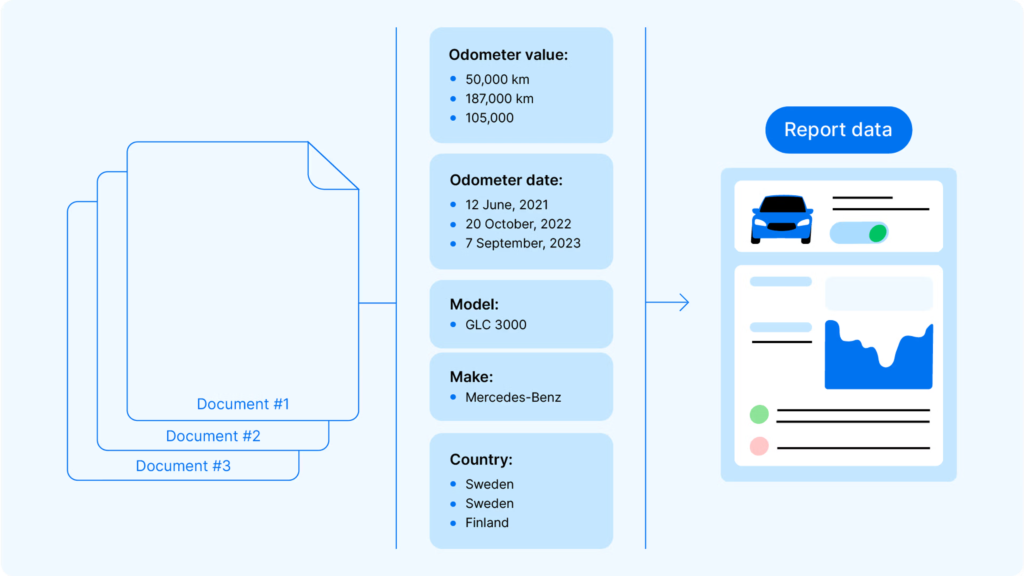
4. We use statistical models and insights to enrich the report
The data has been processed for the carVertical report, but further work is needed using statistical models and other technologies to refine and enhance it. These models help provide insights, such as comparing a car’s mileage with similar vehicles.
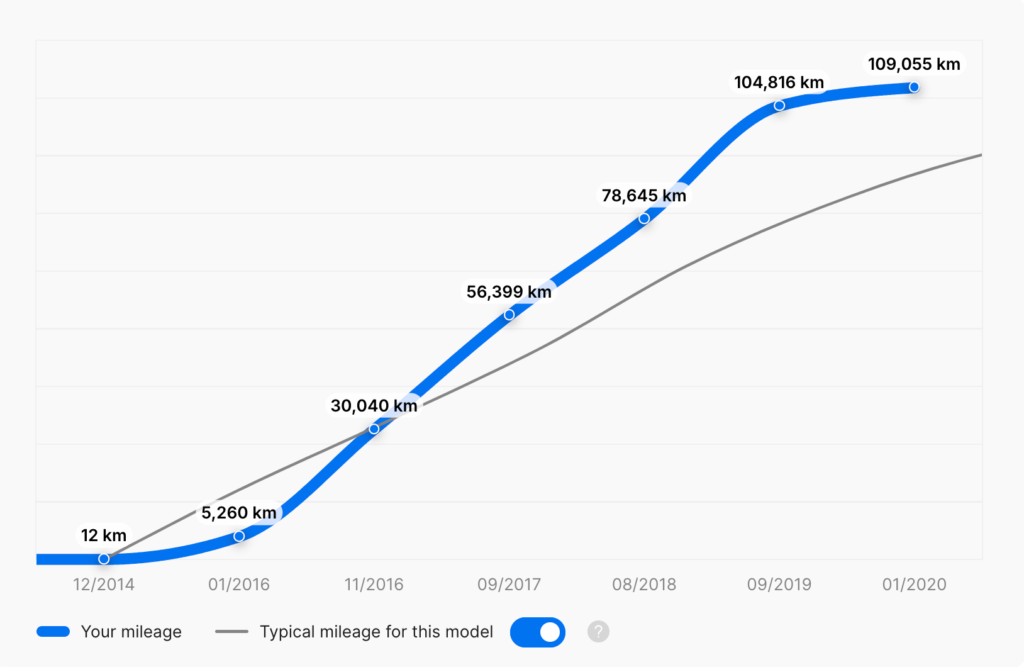
5. You receive a comprehensive vehicle history report
Within minutes, your report is ready!
You can review it online, download it as a PDF, and use it to make a well-informed decision before purchasing a used vehicle.
2. What is a VIN ?
A VIN, or Vehicle Identification Number, is a unique 17-character code assigned to every vehicle. It acts as a fingerprint, providing important details about the car, including its manufacturer, model year, production location, and unique serial number.
The VIN is also essential for verifying a vehicle’s authenticity, tracking key events throughout its lifetime, and ensuring it has not been stolen or tampered with.
Where can I find the VIN?
You can locate the VIN on both the vehicle itself and its official documents.
On a car:
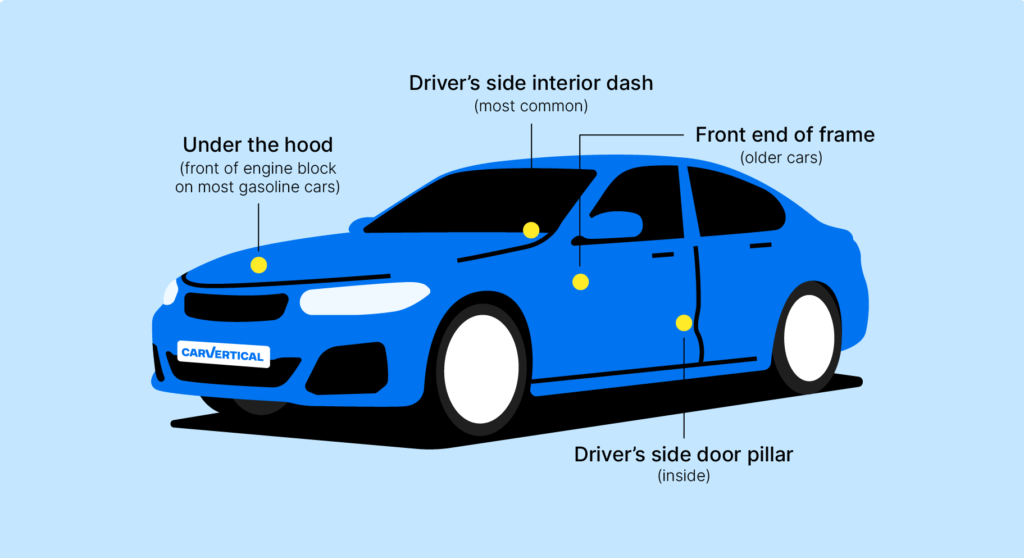
- Dashboard – Check the driver’s side near the windshield.
- Driver’s side door pillar – Look along the side pillar of the driver’s door frame, often near the door hinge.
- Front end of the frame – Check the frame near the front of the vehicle, often on the driver’s side, near the wheel well.
- Under the hood – Some manufacturers place the VIN near the engine block
On a motorcycle:
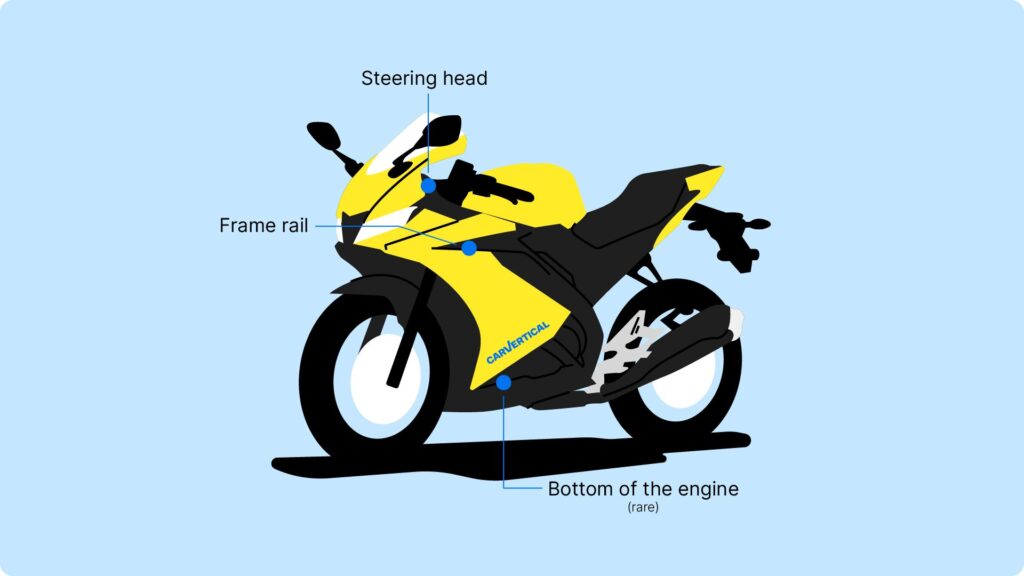
- Steering head (most common) – Typically stamped or engraved on the steering head of the motorcycle, which is the part of the frame that connects to the front fork.
- Frame rail – Some motorcycles may have the VIN located on the frame rail, which is a structural part of the chassis running along the sides of the bike.
- Bottom of the engine (rare) – In rare cases, the VIN may be stamped or engraved on the bottom of the engine.
Tip: The VIN is also printed on official vehicle registration, insurance, and ownership documents. Always ensure the VIN on the vehicle matches the one on the paperwork.
How to decode a VIN
A VIN can be decoded automatically using a VIN decoder or manually by breaking down its structure.
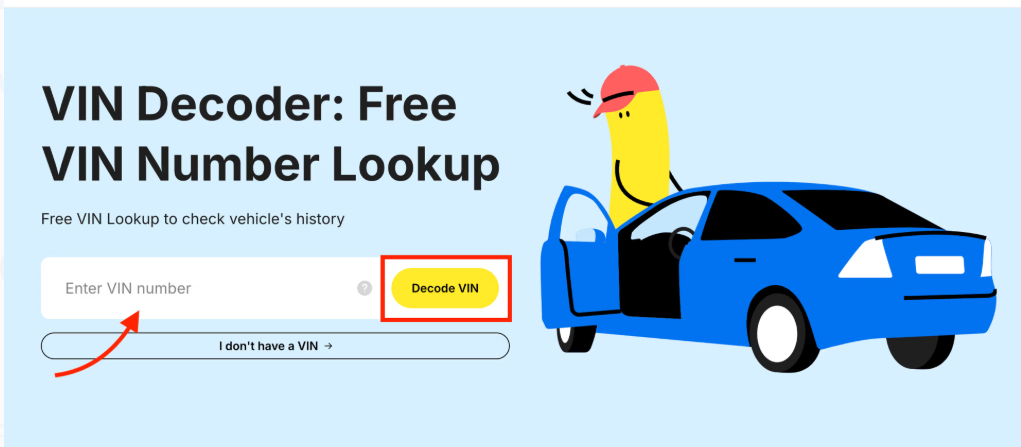
1. Use a carVertical VIN decoder
Just enter the VIN into the carVertical VIN decoder and click Decode VIN.
2. Decode manually
You can also decode a VIN manually if you know what each character represents. However, this can be time-consuming, as manufacturers use different encoding systems for vehicle details.
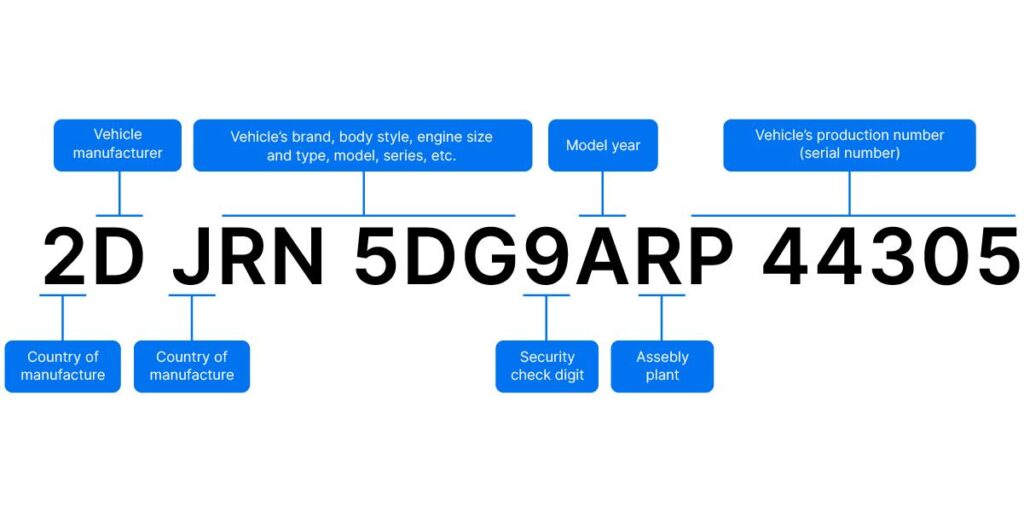
VIN structure breakdown:
- WMI – World Manufacturer Identifier (Characters 1-3): Typically identifies the vehicle’s manufacturer and country of origin.
- VDS – Vehicle Descriptor Section (Characters 4-8): Reveals the vehicle’s brand, body style, engine size, and model type, and similar details.
- Check Digit (Character 9): A security code calculated using a mathematical formula to validate the VIN’s authenticity.
- VIS – Vehicle Identifier Section (Characters 10-17): Characters 10 and 11 indicate the model year and assembly plant, while characters 12 to 17 represent the vehicle’s unique serial number.
How to spot a fake or tampered VIN
A legitimate VIN should always be consistent, clear, and match official records. Here are key warning signs that a VIN might be fake or altered:
- Missing or altered characters
- Physical tampering signs (cratches, uneven paint, altered VIN plate)
- Unusual characters (includes I, O, or Q)
- VIN location mismatch (unusual or non-standard location)
- Check digit mismatch (doesn’t match the calculated value)
- Non-matching documents (VIN on the vehicle doesn’t match the one on its documents), etc.
Always verify the VIN before purchasing a used vehicle to avoid scams.
3. How long will it take to receive my carVertical report?
carVerticals reports are generated almost instantly! You’ll usually receive your report in about one minute or around 40 seconds, to be precise. Our system operates 24/7, allowing you to generate your report anytime, day or night.
Once your report is ready, it will be available in your carVertical account and delivered directly to your email.
4. What information may appear in the carVertical report?
Our data comes from over 1000 trusted sources, including state registries, law enforcement agencies, service records, and other databases. Each report may include different sections depending on the data available for a specific vehicle.
Below is an overview of the key sections that may appear in your report. You can also view a sample report to see what’s typically included and how it looks.